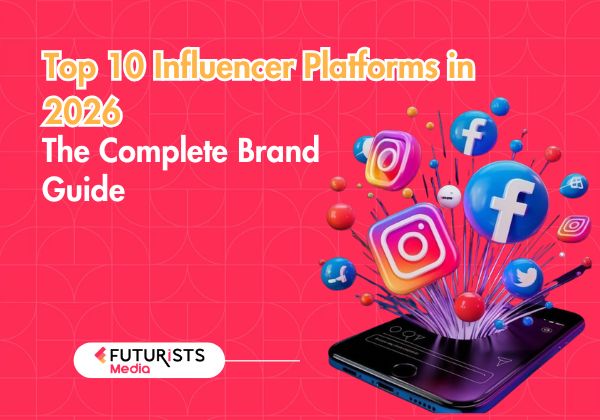
Influencer marketing is no longer a side experiment — it is a foundational pillar of modern digital brand strategy. In 2026, the global influencer marketing industry has crossed $34 billion in value, growing from just $1.7 billion a decade ago. For brands operating in competitive regional markets like Northeast India, the choice of platform can mean the difference between campaigns that convert and budgets that disappear into vanity metrics.
At Futurists Media, we help brands across Northeast India connect with the right creators through smarter strategy and better tools. This guide breaks down the top influencer platforms available in 2026 — who they are built for, what they cost, and what makes each one worth your attention.
The 2026 Influencer Marketing Landscape: What Brands Need to Know
The Numbers Behind the Boom
The influencer marketing industry has grown 19x in a single decade. According to recent benchmarks, the global market reached $32.55 billion in 2025 and is projected to hit $34.1 billion in 2026 under baseline forecasts, with bullish scenarios placing the figure as high as $38.7 billion. Goldman Sachs projects the broader creator economy will reach $480 billion by 2027.
Key performance data for 2026 includes:
- Average ROI: $5.78 per dollar spent on influencer marketing, with top campaigns returning $11–$18
- 74% of marketers plan to actively increase influencer budgets in 2026 (Aspire State of Influencer Marketing Report)
- Nano-influencers now represent 75.9% of Instagram’s influencer base with a 2.71% average engagement rate
- Micro-influencers (10K–100K followers) deliver 3.2x higher engagement at 60% lower cost than mega-influencers
- TikTok maintains an average engagement rate of 3.70% — roughly 7x Instagram’s 0.48%
- B2B influencer marketing grew 47% year-over-year, with brands allocating $4.1 billion in 2026
The Shift That Changes Everything: From Reach to Results
The biggest shift in 2026 is the move away from vanity metrics — followers, impressions, likes — toward measurable business outcomes. Performance-based compensation models are now adopted by 53% of brands. Attribution technology, multi-touch tracking, and AI-driven creator matching are no longer premium features; they are table stakes for any serious platform.
As rising creator costs become the top challenge (reported by 35.4% of brands in the 2026 benchmark survey), the tools you use to discover, vet, and manage creators directly affect your ROI. Choosing the wrong platform means paying for access you do not use, discovery filters that miss your niche, and reporting that cannot answer your leadership team’s most basic question: “Did this campaign drive revenue?”
Top 10 Influencer Platforms in 2026: Detailed Breakdown
We evaluated platforms across five core dimensions: creator discovery quality, campaign management workflow, analytics and attribution, pricing accessibility, and fit for regional or niche brand campaigns. Here is what we found.
1. HypeAuditor — Best for AI-Driven Audience Verification
| HypeAuditor | Best For: Brands that need deep audience authenticity checks and fraud detection Highlight: Analyzes engagement rates, demographics, and authenticity metrics across 137M+ creator profiles |
HypeAuditor stands out in 2026 as the go-to solution for brands that cannot afford to waste spend on fake engagement. Its AI-powered analytics scan audience demographics, engagement authenticity, and follower quality across Instagram, YouTube, TikTok, Twitter, and Twitch. For brands in emerging markets where influencer fraud remains a real concern, HypeAuditor’s vetting capabilities provide a critical layer of protection.
The platform is particularly valuable for campaign planning: you can benchmark a creator’s audience against your target customer profile before committing a single rupee to the partnership.
2. GRIN — Best for DTC Ambassador Programs
| GRIN | Best For: Direct-to-consumer brands building long-term creator partnerships Highlight: AI-powered creator management with Gia bot for enhanced social browsing data |
GRIN is built around the philosophy that creators are brand partners, not distribution channels. Its end-to-end campaign management covers everything from discovery and outreach to contracts, payments, and performance tracking. The Gia AI bot provides enhanced social media browsing data that helps brands understand creator context before outreach.
For brands selling physical products through DTC channels, GRIN’s deep e-commerce integrations and ambassador program management make it a strong fit. It is not the right tool for brands that need quick, one-off activations on a tight budget.
3. Upfluence — Best for E-Commerce Brands with Large Creator Networks
| Upfluence | Best For: E-commerce brands managing 100+ creator relationships simultaneously Highlight: 12M+ creator database with Shopify, WooCommerce, and Magento integrations |
Upfluence powers creator marketing for brands like Marriott, ASICS, Yamaha, and HelloFresh. Its database of over 12 million creators, combined with native integrations with major e-commerce platforms, makes it a strong choice for brands that need to run influencer and affiliate programs in the same workflow. Campaign management, payment processing, and performance attribution are all handled within the platform.
4. Sprout Social Influencer Marketing — Best for Teams Already Using Sprout
| Sprout Social | Best For: Marketing teams wanting influencer and social media management unified Highlight: 9M+ creator database with AI Assist for topic-based discovery and Brand Fit Score |
Sprout Social’s influencer module integrates directly with its broader social media management platform. Its AI Assist technology enables natural language discovery queries — for example, searching for “lifestyle creators in Assam who cover food and travel” — and returns results ranked by a Brand Fit Score that measures topical alignment. For teams already managing organic social through Sprout, the unified analytics dashboard is a significant operational advantage.
5. Modash — Best for Mid-Market Brands Scaling Creator Programs
| Modash | Best For: Mid-market brands needing reliable data at a reasonable price point Highlight: 250M+ creator profiles with native Shopify integration and detailed audience analytics |
Modash covers over 250 million creator profiles and offers audience demographic breakdowns that rival more expensive enterprise platforms. Its native Shopify integration makes it a practical choice for e-commerce brands scaling creator programs without enterprise budgets. The search filters allow discovery by location, engagement rate, audience demographics, and content categories.
6. Favikon — Best for B2B and Multi-Platform Creator Discovery
| Favikon | Best For: B2B brands and agencies running multi-platform creator campaigns Highlight: Covers 9 platforms including LinkedIn, Instagram, TikTok, YouTube, Substack, Pinterest, Twitch, Snapchat, and X |
Favikon is the standout option for B2B influencer marketing, which grew 47% year-over-year in 2026. Unlike platforms that treat LinkedIn as an afterthought, Favikon’s LinkedIn database is structured for B2B discovery. Its unified creator profiles compile social presence across nine platforms into a single view, making it valuable for multi-channel campaigns. At $99/month for entry-level access with data export included, the value-to-price ratio is exceptional.
7. Aspire (formerly AspireIQ) — Best for Community-Driven Campaigns
| Aspire | Best For: Brands focused on community building and long-term creator ecosystems Highlight: Specializes in community-based influencer marketing with strong UGC amplification tools |
Aspire is designed for brands that want to build creator communities rather than transactional influencer rosters. Its 2026 State of Influencer Marketing report data indicates that 86% of creators are willing to collaborate for product gifting when brand alignment is high — a key insight that Aspire’s gifting and gifted collaboration workflows are built to leverage. Social commerce integration and TikTok Shop support are priorities in Aspire’s 2026 roadmap.
8. Creator.co — Best for Agencies Managing Multiple Brand Campaigns
| Creator.co | Best For: Agencies and large brands needing affiliate + influencer in one platform Highlight: 250M+ creators with a 250K+ opt-in creator marketplace and affiliate integration |
Creator.co combines influencer marketing with affiliate management, making it useful for agencies managing multiple brand clients with performance-based compensation structures. The opt-in creator marketplace of 250K+ vetted creators reduces cold outreach friction, which is particularly valuable for brands entering new categories or geographic markets.
9. Collabstr — Best for Small Brands and Startups
| Collabstr | Best For: Small brands and startups running cost-efficient creator campaigns Highlight: Secure payments, brief management, and performance tracking with low entry cost |
Collabstr addresses a gap that larger platforms ignore: nearly 80% of influencer collaboration costs are below $300, but most enterprise platforms are priced well above what makes sense for brands at this budget level. Collabstr’s marketplace model allows brands to discover creators across Instagram, TikTok, and YouTube, communicate securely, and track performance without a monthly SaaS commitment.
10. Brandwatch — Best for Enterprise Social Intelligence + Influencer Discovery
| Brandwatch | Best For: Enterprise brands combining influencer discovery with social listening Highlight: 30M+ creator database with consumer intelligence and social listening engine |
Brandwatch combines deep social listening with influencer discovery in a way that no other platform matches at scale. Its database of 30 million content creators, combined with real-time brand mention tracking and sentiment analysis, makes it a powerful tool for enterprise brands that need to understand cultural conversations before briefing creators. If your brand needs both social intelligence and influencer management in a single contract, Brandwatch is the platform to evaluate.
How to Choose the Right Influencer Platform for Your Brand in 2026
With dozens of platforms available, the right choice depends on five factors specific to your brand situation:
1. Define Your Campaign Goal First
Are you building brand awareness, driving direct sales, generating UGC for paid social, or scaling an existing creator program? The platform that excels at enterprise awareness campaigns is rarely the right fit for a DTC brand that needs UGC for Meta ads. Map your primary goal before evaluating any platform.
2. Match Creator Tier to Budget
Nano-influencers (1K–10K followers) now achieve the highest engagement rates on both Instagram (2.71%) and TikTok (10.3%). Micro-influencers deliver 3.2x higher engagement at 60% lower cost than mega-influencers. For brands with regional focus — like Northeast India — a roster of 20–30 nano and micro creators will consistently outperform a single macro partnership.
3. Prioritize Attribution Capabilities
The biggest operational gap for most teams in 2026 is attribution. The gold standard combines unique UTM links, promo codes, and affiliate tracking. Platforms that cannot connect influencer activity to revenue impact should be eliminated from your shortlist regardless of their discovery features.
4. Check Platform Coverage for Your Market
Most global platforms index creators in tier-1 markets deeply but have sparser data for regional creators in India’s Northeast. Before committing to any platform, test its discovery quality by searching for creators in your actual niche — for example, “food creators in Assam” or “lifestyle influencers from Meghalaya” — and evaluate the quality of results.
5. Trial Before You Commit
HypeAuditor, Modash, and several other platforms offer free trials. Run a small campaign through each finalist’s workflow to assess operational friction. Ask: Does the briefing tool match how my team works? Can I pull the reports my leadership team will ask for? If the answer is no on either count, move to the next option.
Final Thoughts: Building a Platform Strategy That Works
The influencer marketing landscape in 2026 is more sophisticated, more performance-driven, and more competitive than ever. The brands winning in this environment are not those with the biggest budgets — they are the ones using better tools, making smarter creator matches, and measuring outcomes that matter to their business.
For brands in Northeast India, the opportunity is significant. Regional creator audiences are highly engaged, brand relationships tend to be authentic, and the competition for quality creator partnerships is lower than in saturated metro markets. The right platform strategy — backed by the right agency partner — can transform influencer marketing from a line item into a growth engine.
FAQ
What is the best influencer marketing platform in 2026?
There is no single best platform. HypeAuditor leads for audience verification and fraud detection. GRIN and Upfluence are strongest for DTC e-commerce. Favikon stands out for B2B campaigns. Modash offers the best value-to-price ratio for mid-market brands. The right platform depends on your campaign goals, budget, and creator tier.
How much does influencer marketing cost in 2026?
Costs vary widely by creator tier. Nano-influencers (1K–10K followers) typically charge $50–$500 per post. Micro-influencers (10K–100K) range from $500–$5,000. Macro and mega-influencers start at $10,000+ per activation. For brands with regional focus and limited budgets, nano and micro collaborations offer the strongest ROI.
Which social media platform is best for influencer marketing in 2026?
Instagram retains the highest volume of brand campaigns at 57% preference. TikTok leads on engagement rate (3.70%) and is the primary driver of social commerce through TikTok Shop. YouTube remains dominant for long-form credibility content and product reviews. A multi-platform strategy is now standard for brands running serious creator programs.
How do I measure influencer marketing ROI in 2026?
The most reliable measurement combines UTM tracking links, unique promo codes, and affiliate platform tracking (Refersion or Impact.com). Multi-touch attribution models that capture the full influence path — not just the last click — are increasingly important. The average industry return is $5.78 per dollar spent; top-performing campaigns return $11–$18.
Are nano-influencers worth it in 2026?
Yes. Nano-influencers now represent 75.9% of Instagram’s influencer base and achieve the highest engagement rates across most categories. On TikTok, nano-tier creators achieve 10.3% engagement — the highest of any tier. For regional brands targeting specific geographic or cultural audiences, nano-influencers offer unmatched authenticity and cost efficiency.